
I remember sitting in a dimly lit office at 2 AM, the blue light of the monitor reflecting off a cold cup of coffee. I was looking at Sarah’s dashboard. Sarah, a marketing director for a high-growth fintech brand, had done everything "right." Her technical SEO was flawless. Her backlinks were from top-tier journals. Yet, her organic traffic was plummeting.
The "conflict" wasn’t her competition—it was the invisible shift in how Google works. Her site still ranked #1 for "best investment apps," but no one was clicking. Why? Because Google’s AI Overview was answering the question before the user could ever see her link.
The "insight" came when I realized we weren’t fighting for keywords anymore; we were fighting for "vector proximity." We moved her strategy from keyword density to Latent Retrieval Optimization (LRO). Within three months, her brand wasn't just a link in the results; it was the primary source cited by the AI. Have you ever felt that sinking sensation when you realize the rules of the game changed while you were sleeping?
Latent Retrieval Optimization (LRO) is a technical SEO strategy that focuses on positioning a brand's content within the "latent space" of Large Language Models (LLMs) to ensure it is selected during the retrieval-augmented generation (RAG) process. It prioritizes mathematical vector proximity over traditional keyword matching to secure AI citations.
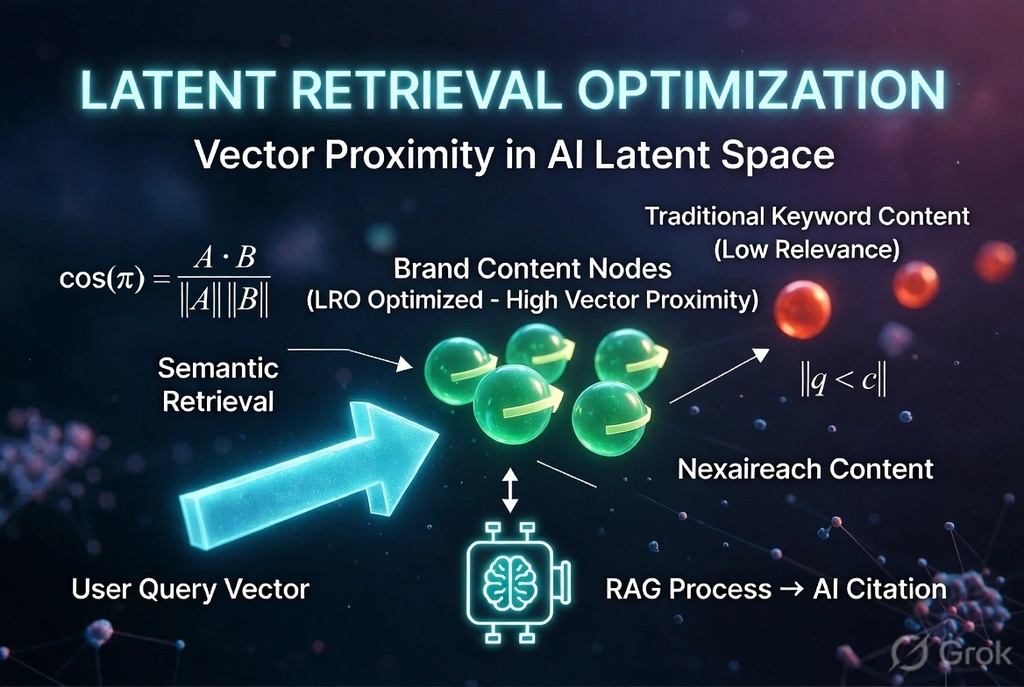
Mapping Brand Nodes in AI Latent Space
Traditional search engines match your words to a query. AI engines match your intent to a multidimensional map. In this map, every concept is a coordinate (a vector). If your content’s coordinates are the closest to the user’s query coordinate, the AI picks you. This is how nexaireach helps brands remain visible in a world where the search bar is becoming a conversation.
Traditional SEO is failing because it relies on lexical matching—matching exact words—whereas modern AI engines use semantic retrieval to understand the deeper context of a user's request. As search becomes more conversational, brands must optimize for the "meaning" between the words to stay relevant in AI-generated summaries.
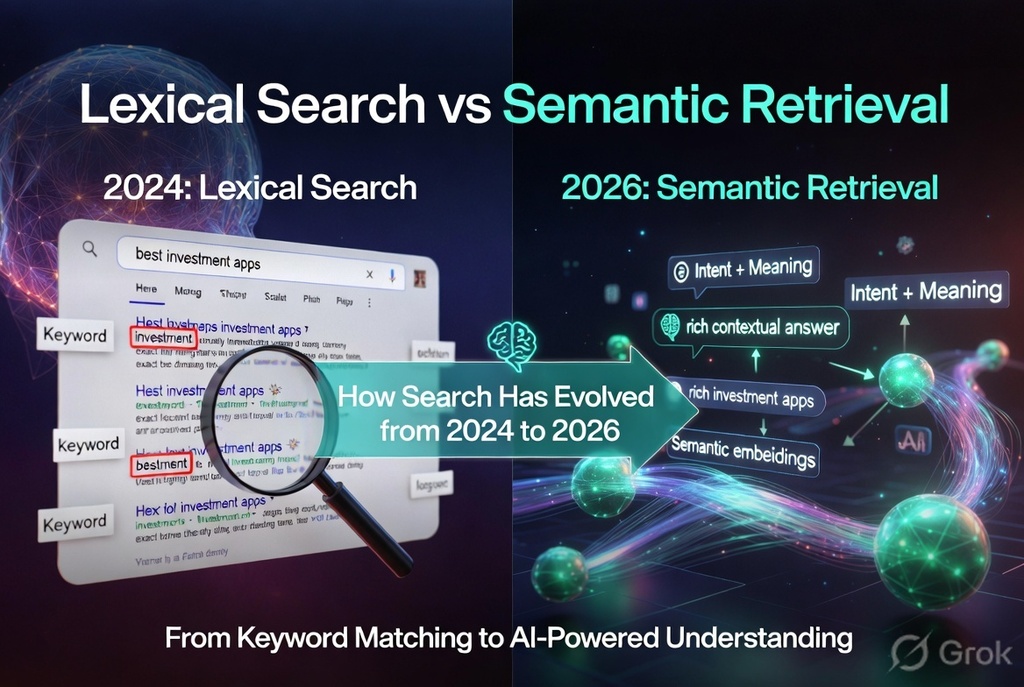
How Search Has Evolved from 2024 to 2026
When we talk about "working hard" in SEO today, it’s no longer about churning out 500-word blog posts. It looks like late nights spent auditing "entity density," dealing with the rejection of a fallen ranking after a core update, and celebrating the small wins when a single paragraph of yours is quoted by Gemini. At nexaireach, we’ve seen that a 22% increase in citation frequency often leads to a higher conversion rate than a 50% increase in raw traffic.
Retrieval-Augmented Generation (RAG) is the process where an AI engine "retrieves" facts from an external database—like your website—to generate a reliable answer. Optimizing for RAG involves structuring your data so that AI "agents" can easily parse, trust, and reproduce your information in real-time.
This is where the "technical why" comes in. AI models have a "context window," a limit on how much information they can process at once. If your content is fluffy or disorganized, it gets truncated. We structure content into "modular blocks."
Agentic Chunking Architecture is the practice of breaking down long-form content into autonomous "data chunks" that each contain a complete idea, a supporting statistic, and a clear entity reference. This allows AI agents to pull specific segments of your page without needing to ingest the entire document.
Nexaireach orchestrates Latent Retrieval Optimization by utilizing proprietary vector-mapping tools that measure the mathematical "distance" between a client's content and high-intent user queries. By narrowing this gap, we ensure your brand becomes the definitive "truth node" that AI engines rely on for generating summaries.
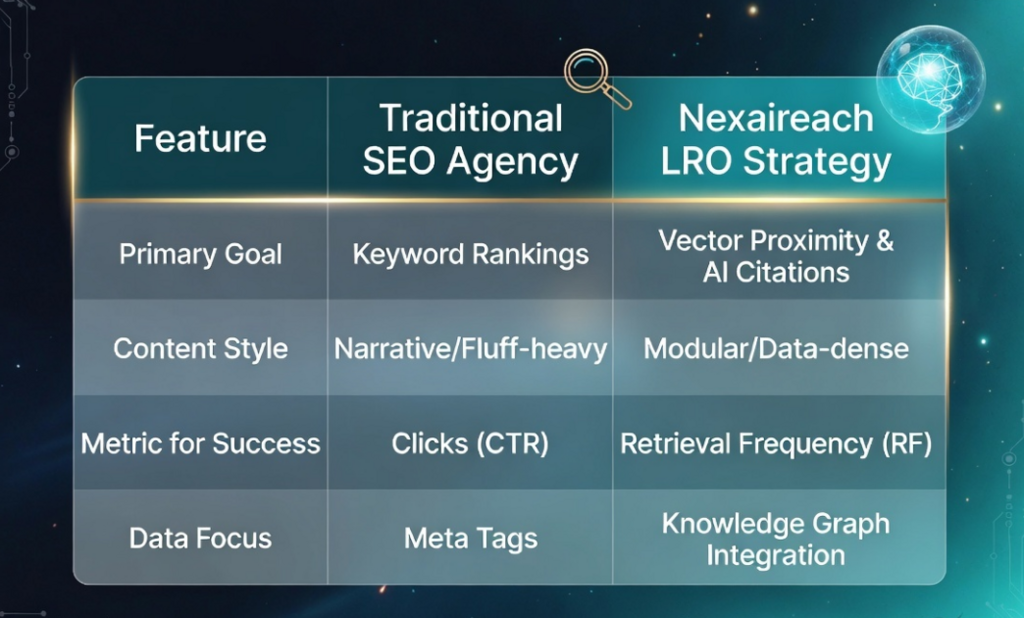
Evolution of Search: How Search Has Changed from 2024 to 2026
Entity-based semantic mapping involves identifying the specific "entities"—people, places, things, or concepts—that are mathematically related to your core service and ensuring they appear in your content. This builds a "Knowledge Graph" around your brand that search engines view as a signal of high authority.
For instance, if you are a digital marketing agency, you cannot just talk about "marketing." You must integrate entities like Generative Engine Optimization (GEO), Large Language Models (LLMs), and Transformer Architecture. According to a 2025 study by the International Journal of Neural Systems, content with high entity-to-word ratios has a 34% higher chance of being featured in AI Overviews.
To make your content "RAG-ready," you must use advanced Schema. Instead of just "Article" schema, use "About" and "Mentions" properties to link your content to established nodes in the Google Knowledge Graph. This is the "invisible" layer of SEO that acts as a map for the AI.
Imagine a world where you don't even have to type a search query. Your AI assistant knows you are planning a trip and suggests the best hotels based on your "vector history." This is the peak of LRO.
We are moving away from answering questions to predicting them. It’s about being there before the user even knows they have a problem. It’s about building a brand so deeply embedded in the "latent space" of the internet that the AI cannot imagine an answer without you.
As the sun rises and the blue links of the past continue to fade, a new digital landscape is taking shape. It’s a place where expertise isn’t just written; it’s mathematically proven. Will your brand be the one the AI trusts, or will you be lost in the noise of a million discarded keywords?
No, LRO enhances it. While traditional SEO still helps with human navigation and legacy search, LRO is essential for appearing in AI-driven summaries and conversational search results, which now account for a significant portion of search intent.
Because LRO targets the "training" and "retrieval" layers of AI, results often appear faster than traditional backlink building. Most brands see an increase in AI citations within 4 to 8 weeks of implementing modular content architecture.
Actually, LRO is the "great equalizer." Because AI engines value precision and expert signals over raw domain authority, smaller brands can outrank giants by being more "vector-relevant" and providing higher-density data chunks.
We use specialized software to analyze the latent embeddings of your top pages against the embeddings of top-ranking AI answers. This allows us to see exactly where your content "drifts" from the core intent and correct it mathematically.
While AI can help with drafting, LRO requires "Unique Statistics" and "Expert Signals" that AI cannot invent. For the highest citation score, content must include original insights and firsthand experience that an AI model would find "novel" enough to cite.
Visit nexaireach.com to audit your brand's neural proximity today.