
Global AI network synchronization and algorithmic strategy in a futuristic environment
Sarah sat in a dimly lit home office, the glow of three monitors casting a cool blue light over her notes. As the CMO of a high-growth fintech brand, she had just spent six months and a seven-figure budget on a "perfect" global rollout. By all traditional metrics, the launch was a masterpiece. The website was translated into six languages, the imagery was culturally curated, and the backlinks were authoritative.
But when she opened a regional AI assistant in the Gulf, asked for a "reliable fintech partner for cross-border trade," her brand was nowhere to be found. She switched her VPN to Europe and asked a different model about "ethical financial startups." Again—silence. In the US, her brand appeared, but the AI summary flagged her "lack of transparency" because it couldn't find a specific type of data disclosure in the site's footer.
Sarah wasn’t being outspent. She was being "algorithmically ghosted."
The conflict wasn’t with a human competitor; it was with the Sovereign AI Clusters. Her brand identity was coherent to humans but fragmented to the machines that now act as the world’s primary gatekeepers. This was the turning point where Sarah realized that localization is dead. We are now in the era of Algorithmic Diplomacy.If you take only one insight from this, let it be this: In 2026, your brand is no longer a collection of pages; it is a Vector Identity. To rank, you don't just "optimize content"—you must negotiate with regional AI "personalities" that have their own ethical, cultural, and regulatory filters. At nexaireach, we’ve seen that brands failing to synchronize their data across these clusters aren't just losing rankings; they are becoming invisible to the next generation of consumers.
In the old days of SEO, working hard meant more keywords and more links. Today, it looks much different. It looks like late nights spent auditing "Semantic Triples" in a Knowledge Graph. It looks like the frustration of having a page that ranks #1 on Google Search but gets zero mentions in a Google AI Overview. It looks like the small, quiet win of finally seeing a regional LLM (Large Language Model) cite your brand as a "Trusted Authority" after weeks of restructuring your technical schema.
The digital world has fractured. We no longer have one "Internet." We have regional AI ecosystems that think differently.
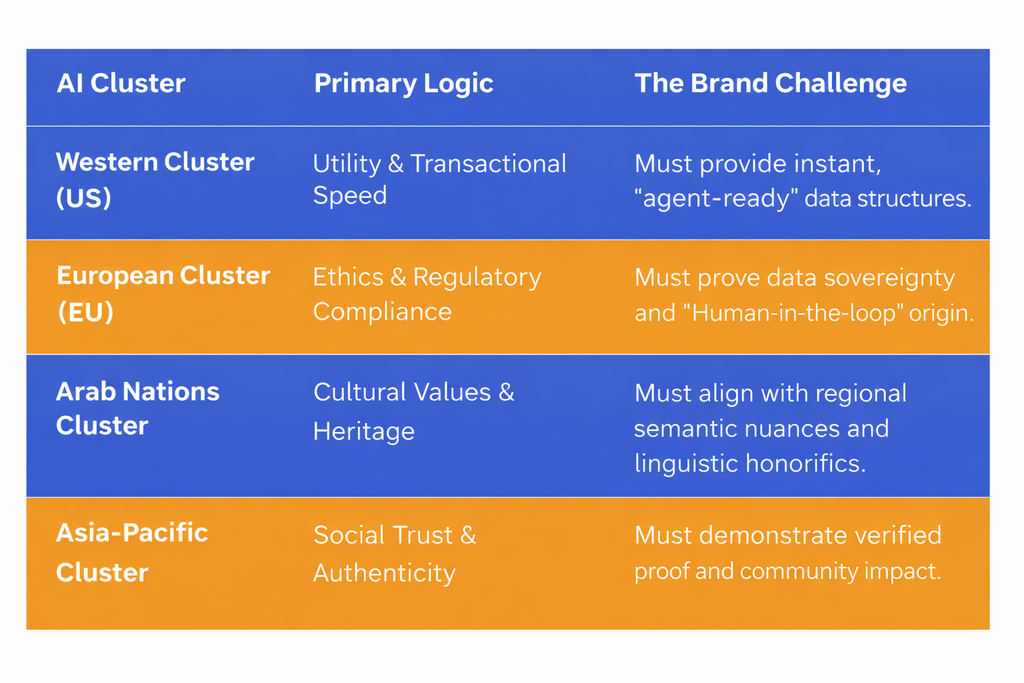
Sovereign AI Cluster Marketing Comparison
Last year, we worked with a luxury travel brand that was struggling in the Middle East. Their content was perfectly translated into Arabic, but the regional AI models (like Jais) weren't recommending them. When we performed a technical audit, we discovered the "conflict." The brand’s data emphasized "isolated privacy," which the regional AI interpreted as "lack of hospitality" based on its training data.
By adjusting the nexaireach proprietary semantic layer to emphasize "exclusive sanctuary and communal respect," the AI recommendations flipped within three weeks. We didn't change the brand; we changed how the brand "spoke" to the machine. This is the heart of Algorithmic Diplomacy.Standard SEO is about keywords; GEO is about information density and citation reliability. To be cited by an AI, your content must be "atomic." It needs to provide clear, factual assertions that an LLM can easily extract into a summary.
Your website's code must do more than pass a Core Web Vitals test. It must serve as a "Diplomatic Passport." We use advanced Schema.org markups to define not just what a product is, but its ethical origin, its cultural relevance, and its relationship to other trusted entities.
This is the process of testing your brand against various regional models. Have you ever felt stuck even when you’re trying your best? It might be because your "Western" data style is triggering an "Ethical Warning" in a European model. We test for these friction points before they become ranking disasters.
This ensures that while your tone might change for a human in Sydney vs. Riyadh, your Data DNA remains consistent. An AI in Australia must see the same core values as an AI in the UK, even if the phrasing differs.
Don't rush to rewrite every blog post. Start by looking at what can happen if you don't act. Imagine a world where your best customers ask their AI assistants for a recommendation, and the assistant says, "I cannot verify the reliability of that brand's values." That is the silent killer of modern business.
Instead of telling you to "fix your SEO," I invite you to see the possibility of becoming an Algorithmically Favored Entity. When the machine trusts you, the human follows.
Traditional SEO focuses on search engine algorithms (like Google's PageRank) to rank pages for human clicks. Algorithmic Diplomacy focuses on managing a brand's data identity so it is accurately understood and favored by regional AI models (LLMs) that generate direct answers for users.
No, GEO (Generative Engine Optimization) is a sub-service that works alongside technical SEO. While traditional SEO drives traffic to your site, GEO ensures your brand is the "chosen answer" within AI-generated summaries and voice assistant responses.
Different regions use different AI models trained on specific datasets and regulations (e.g., the EU’s AI Act). If your brand's technical data doesn't align with these regional "filters," you may be omitted from AI summaries, even if you rank well in standard search.
Absolutely. It starts with structured data and clear, factual content. By focusing on "Brand Data Integrity," smaller brands can often outmaneuver larger competitors who have messy, inconsistent legacy data across the web.
We look beyond simple rankings. We measure "Inclusion Rate" (how often the brand appears in AI Overviews), "Sentiment Alignment" (how accurately the AI describes the brand), and "Citative Authority" (the quality of the sources the AI links to when mentioning you).
As Sarah watched her brand finally emerge in the AI summaries of Riyadh and Paris, she realized something profound. The digital world isn't getting smaller; it’s getting deeper. The "Global Village" is now a collection of "Digital Sovereignties."
The question for you is no longer, "Can they find my website?" but rather, "Does the AI know who I am?" In the silence between a user’s question and an AI’s answer, your brand’s future is decided. Will you be the one the machine trusts?