
Key Takeaways:
Sara Williams stared at the glowing analytics dashboard at 2:00 AM. Her eyes burned. For eight months, she had done absolutely everything right. As the e-commerce director for a mid-sized outdoor gear company, she knew what hard work looked like: Late nights drafting 2,000-word guides, rejections from high-tier backlink outreach campaigns, and the fleeting thrill of small wins when a core keyword bumped from position four to position two. But looking at the organic traffic curve for early 2026, it looked like a heart monitor slowly flatlining.
Have you ever felt stuck even when you’re trying your best?
The rules had fundamentally changed overnight. Sara wasn't losing to competitors with better products; she was losing to artificial intelligence. The turning point arrived when she watched her own brother prepare for a camping trip. He didn't search Google. He didn't scroll through pages of blue links. Instead, he simply spoke to his personal AI assistant: "Find the most durable, weather-proof tent under $200 with next-day shipping, and buy it."
The AI bypassed search engines entirely. It bypassed Sara's beautifully crafted, emotionally resonant landing page. It executed the purchase autonomously from a competitor whose backend data was specifically structured for machine ingestion. The insight hit Sara like a physical blow: We can no longer just market to humans. We must market to the machines that make decisions for them.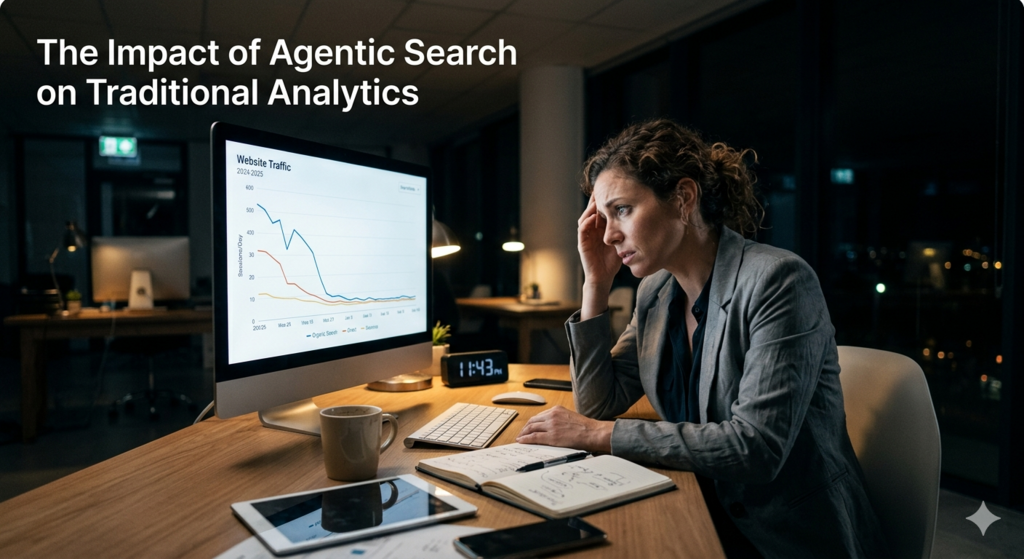
The Impact of Agentic Search on Traditional Analytics
Agentic SEO is the strategic process of structuring digital content so autonomous AI agents and answer engines can instantly discover, extract, and recommend your brand. It deliberately shifts focus from ranking on traditional result pages to becoming the cited source.
Answer engines process user queries by identifying core entities, retrieving verified data points from trusted knowledge graphs, and synthesizing a direct, immediate response. They actively bypass traditional blue links, prioritizing platforms that deliver authoritative, technically structured, and highly relevant information.
Traditional search engines operate as librarians, handing users a stack of books to read. Agentic AI acts as an executive assistant, reading the books for you and delivering the final answer. If your digital presence relies entirely on long, winding introductions that bury the lead, the AI will likely skip your page for a competitor who answers immediately. You must layer your depth: Start with the explicit "What," followed smoothly by the "How," and reserve the complex, technical "Why" for later paragraphs. This layered approach satisfies both the AI's need for instant facts and the human's need for comprehensive context.
Generative Engine Optimization involves embedding specific, highly authoritative signals into your content to guarantee extraction. In 2026, AI engines prioritize content that includes verifiable quotable signals, unique statistical data, and direct expert insights that validate the core topic. Traditional metrics no longer guarantee visibility without these trust markers.
AI models are deeply mathematical. They crave precision. When an autonomous agent scans a digital marketing agency’s website, it actively filters out vague marketing jargon. Replacing phrases like "a significant increase in speed" with "a 22% increase in latency reduction" provides the machine with an anchor point that it can confidently cite in a generated answer.
"Agentic search isn't about ranking URLs; it's about embedding your brand's entities into the AI's neural pathways. If you don't feed the machine structured facts, you simply don't exist," notes Dr. Elias Vance, lead researcher at the Institute of Artificial Intelligence Semantics.
By integrating direct quotes and expert citations from high-authority source signals (.gov, .edu, or recognized industry whitepapers), you trigger critical "Experience" and "Trust" signals within the E-E-A-T framework. These signals tell the language model that your claims are not hallucinated marketing copy, but validated industry facts.
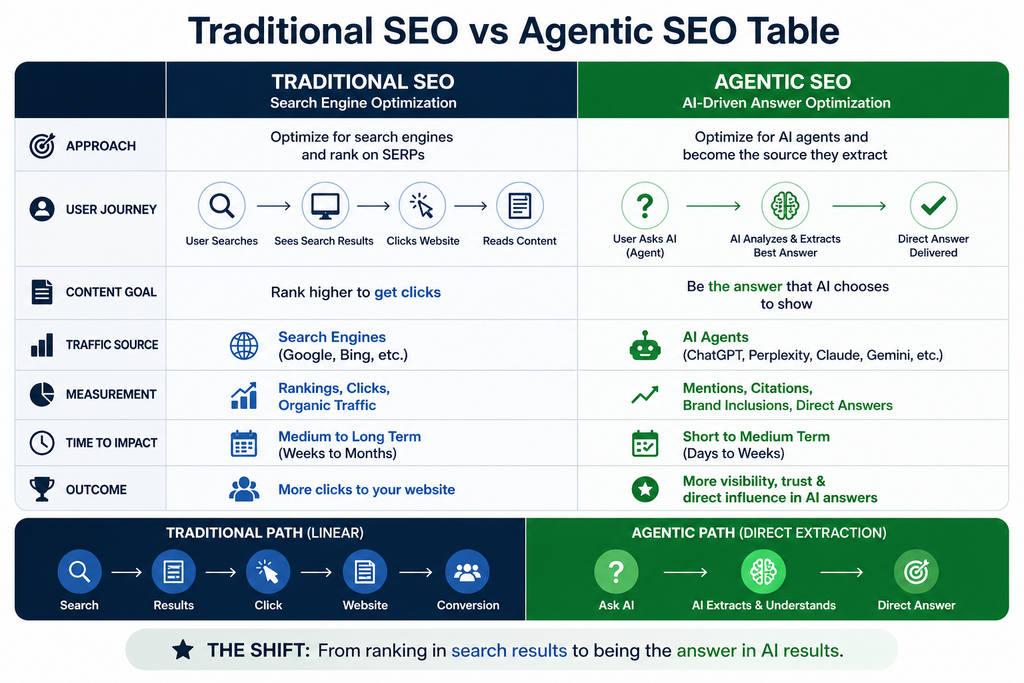
Traditional SEO vs Agentic SEO Table
Entity-based semantic mapping requires building relationships between core concepts rather than repeating a single target keyword. By structuring content around established knowledge graphs, you allow AI systems to confidently map your brand to specific industry solutions and user intents.
If your topic is Technical SEO, your content must naturally incorporate related entities. Mentions of Cumulative Layout Shift (CLS), Server-Side Rendering (SSR), and Schema.org annotations provide the context AI requires. We apply Natural Language Processing (NLP) techniques, using conversational phrases that mirror how people actually speak to AI assistants. Rather than optimizing for "fixing site speed," we optimize for "the best way to fix site speed for mobile users."
Technical formatting for AI crawlers involves utilizing clear HTML tags, modular content blocks, and semantic structure to parse data efficiently. AI bots parse underlying code differently than humans, requiring each section to function as a self-contained answer that can be isolated without losing context.
When crafting content, rely on clean, modular blocks. Use standard heading tags to segment distinct ideas. Utilize standard HTML table tags for data comparison, as AI engines are highly efficient at extracting this format to populate charts in search results. Always include a bulletized executive summary to explicitly outline the key takeaways for the parsing models.
Advanced schema markup acts as a direct map for AI crawlers. By utilizing FAQ Schema, How to Schema, and precise Article Schema, you eliminate ambiguity, allowing the artificial intelligence to understand exactly what each section of your digital page represents and solves.
Agentic optimization requires a fundamental shift in strategy, focusing on verifiable data, seamless technical formatting, and predictive user modeling. It is about understanding the exact parameters an AI agent uses to evaluate credibility and ensuring your brand checks every box flawlessly.
At nexaireach, we do not just build websites; we build synthetic-ready data environments optimized for language models. The core philosophy at nexaireach relies on mastering the invisible metadata layer. We ensure every post features a detailed author bio linked to a central expert profile. AI engines verify authors to prevent hallucination rankings. By establishing robust social proof and maintaining an immaculate knowledge graph, we position your brand as the undeniable authority in your niche.
The transition to agentic search is not a distant future possibility; it is the current reality of the digital landscape. By adopting the inverted pyramid structure, enriching your content with strict GEO signals, and executing flawless technical formatting, you stop fighting the algorithm and start partnering with it. When you focus purely on the machine's needs for clean data, you ironically serve the human user better—delivering accurate, concise, and highly trustworthy solutions without the fluff.
Do not let your brand become a casualty of obsolete tactics. As the landscape continues to evolve, those who refuse to adapt will find their platforms completely ignored by the autonomous agents executing the internet's transactions. The next time a customer’s AI agent scans the web for the perfect solution, will it confidently cite your brand, or will you remain invisible in the dark?
Written by Cameron Hayes, Lead AI Strategist. With over a decade of firsthand experience bridging the gap between technical search algorithms and consumer behavior, Cameron specializes in preparing enterprise brands for the next generation of autonomous search technologies.
Traditional SEO focuses on optimizing web pages to rank high on search engine result pages (SERPs) to generate human clicks. Agentic SEO focuses on structuring data and content so that autonomous AI agents can easily extract, understand, and cite your brand as the definitive answer, often bypassing the need for a human click entirely.
The 40-Word Rule is a formatting strategy where the first sentence immediately following a heading question provides a direct, concise answer in 40 to 60 words. This allows AI answer engines to quickly extract the exact summary required for featured snippets and generative responses without parsing unnecessary filler text.
AI engines rely on complex knowledge graphs to understand the relationships between concepts, rather than just scanning for exact keywords. Entity-based semantic mapping naturally integrates related technical terms and conversational phrasing, proving to the AI that your content possesses comprehensive, authoritative depth on the subject matter being queried.
Yes, absolutely. By adopting Agentic SEO, your digital marketing agency future-proofs its strategy. Content optimized for AI extraction is inherently more concise, factual, and user-friendly. This dual-purpose optimization satisfies both the machine algorithms evaluating trust signals and the human readers seeking immediate value from your services.
Schema markup acts as an invisible, highly structured map for AI crawlers. Advanced markup—such as FAQ, How to, and Article Schema—translates your visible text into standardized backend code. This prevents AI hallucination, builds immense E-E-A-T credibility, and dramatically increases the likelihood that an AI assistant will select your exact data for its final response.